
Doug Melvin
Monday, October 3, 2016 | 3 minutes
How to Become a Master of Time
Intro
As a professional engineering team manager with experience and background in project management and business analysis as both a consultant and full time employee, consistency, quality, and timeliness of delivery are expected by every organization I’ve had the opportunity to work with. I take this expectation to heart and, frankly, have made it a part of my identity as a professional, in an effort to meet the needs of my clients and employers.
Working both with and for multiple teams, I consult, organize, communicate, and manage a vast amount of resources and information flow each day. To ensure that I am always best able to meet my deadlines and communicating effectively with those I work with, time management and prioritization of both scheduled and ad-hoc topics are critical.
Luckily, there are two major tools that help me keep my days flowing smoothly.
The Eisenhower Matrix
While navigating multiple projects, the Eisenhower Matrix helps project manager organize their days while juggling unexpected tasks. Based on the criterion of importance and urgency, PM/BA’s sort their tasks and complete, delay or delegate by categorizing them into one of the below four quadrants:
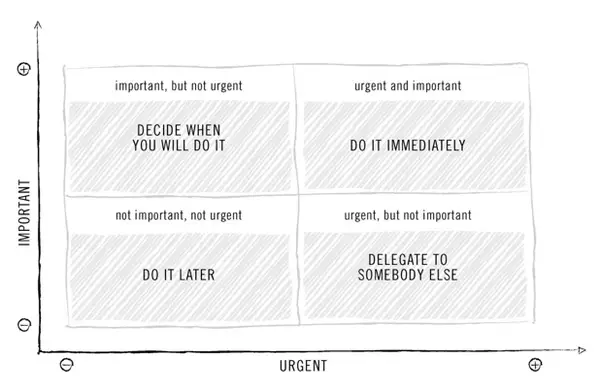
The simple framework of the matrix allows for easy visualization without complicated tools; a whiteboard or corkboard will do just fine. or those interested in a more portable method, Trello published a great blog post on how to use their tool to apply the Eisenhower matrix. If you’re familiar with Agile, an Information Radiator can also be used to visualize and sort tasks.
Regardless of how you draw the matrix, getting all the information out of your head and organized in one place makes decision-making less arduous and your work day more productive.
The Pomodoro Technqiue
Instead of racing to a deadline or fighting the lure of procrastination, the Pomodoro Technique is a simple time management system that breaks the work day into intervals with short breaks designed to eliminate burn-out and fight distractions.
Created in the late 1980’s by Francesco Cirillo, the approach divides each day into 25 minute work-periods — or Pomodoros — that are surrounded by short and long breaks. Short breaks are 5 minutes; long breaks are 25 minutes and are allowed only after four Pomodoros have been completed. Work should be done consistently through each Pomodoro and should stop only at break times. In a professional setting where email and IM’s are constant, it’s important not to use the break times for checking email. Instead, short breaks are good times to get up, get a glass of water or a snack. Long breaks are well spent getting some fresh air, getting lunch or just going out for a cup of coffee.
There are even some tools to help keep you on track. This Google Chrome extension blocks websites until it’s time for a break.

The Pomodoro Technique was named after the Italian word for tomato. It’s creator, Francesco Cirillo, was inspired by his kitchen timer, shaped like a tomato.
For our project managers whose goal is ensuring development teams meet deadlines and complete deliverables, the Pomodoro Technique is especially helpful for creating accurate project timelines by estimating the number of Pomodoros it will take to complete a task.
While these methods can work on their own, the true magic of the Pomodoro Technique and the Eisenhower Matrix become apparent when the two systems work in conjunction. Using the Eisenhower method for decision-making and the Pomodoro Technique for execution leads to a more efficient and productive workday, while maintaining quality and consistency throughout every project.